
Published 2026-05-29 / Updated 2026-05-30
How to Write the Cursive Alphabet (A to Z) + Practice Tips
How to write cursive writing a to z with a stroke-first method, practice order, and join tips. Focus keyword: how to write cursive writing a to z.
Article type: Copy and paste guide
Unicode characters may render differently by device, browser, app, and font. Test decorative text in the exact place where you plan to use it.
English
SEO summary (<=100 chars): Learn how to write cursive writing a to z with a simple, practical practice order.
Focus Keyword: how to write cursive writing a to z
Meta description (EN): How to write cursive writing a to z with strokes, practice order, joins, and quick tips.
If you're searching **how to write cursive writing a to z**, you probably want one clear thing: a practical way to learn (or relearn) the cursive alphabet without guessing every letter shape.
!how to write cursive writing a to z practice sheet
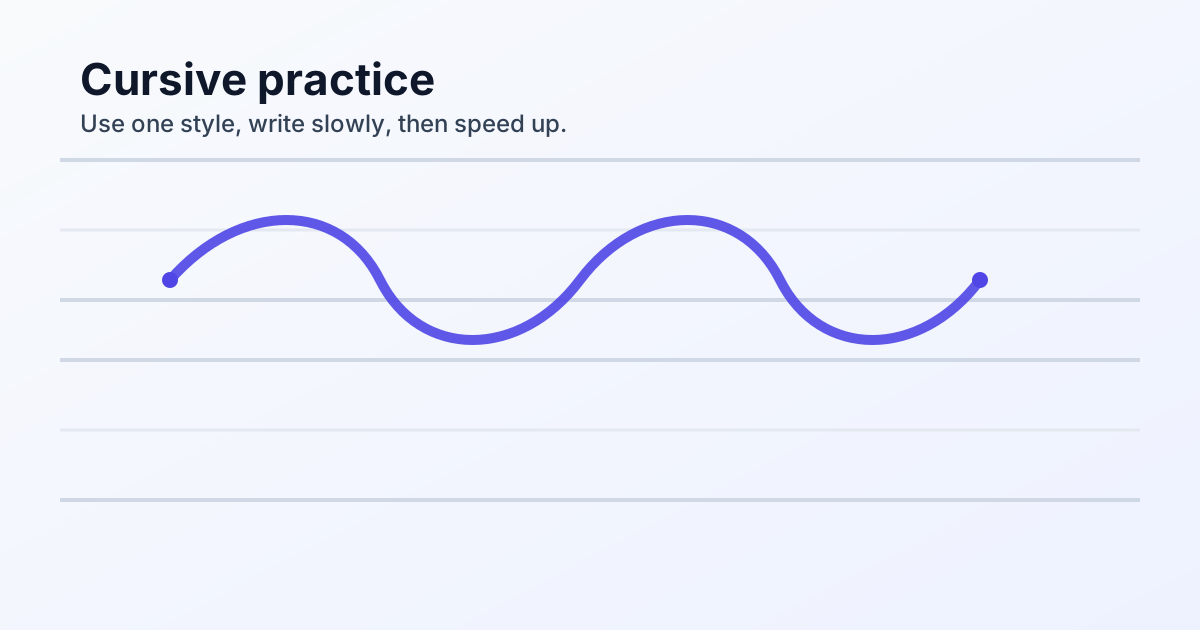
External link (basic reference): Cursive
Here's the most reliable approach:
- **Pick one reference alphabet** (a school sheet, workbook, or a single style you'll stick with).
- Learn the **core strokes** first (most letters repeat the same few motions).
- Practice **lowercase A-Z** in a smart order (easy families first), then do uppercase.
- Practice **connections** (because joins are what makes cursive feel "cursive").
Note: There isn't one universal cursive alphabet. Letterforms vary by region, teacher, and workbook. This guide shows a method that works across styles, and calls out where variations are common.
What you need (keep it simple)
- **Lined paper** (wide-ruled helps at the beginning)
- **A smooth pen or pencil**
- **A reference** (print it or keep it beside you)
If you need quick practice \"guidelines\" in a notes app or bio, CopyBox also has a blank space copy page you can use to create consistent spacing (always test in your target app).
The 5 core cursive strokes (learn these before A-Z)
Most cursive alphabets are built from a few repeatable strokes. Warm up for 3-5 minutes with:
- **Undercurve** (light curve up from the baseline)
- **Overcurve** (start higher and curve down into the baseline)
- **Upstroke / downstroke** (steady slant and spacing)
- **Oval** (for letters like `a`, `o`, `c`)
- **Loop** (often used in `l`, `e`, `f`, `g`, depending on style)
If your strokes are smooth, the alphabet gets much easier.
Lowercase cursive a to z (best practice order)
Instead of practicing `a b c d ...` in order, practice by **letter families**. Within each family, focus on:
- consistent height (baseline -> midline)
- consistent slant
- clean exit stroke (so you can connect to the next letter)
Family 1: i, u, w (the "hump" letters)
These teach rhythm and spacing.
- `i`: one hump + a dot (dot later, after the word)
- `u`: two humps
- `w`: three humps
Related: how to write w in cursive
Family 2: n, m, h (arches + tall stroke)
These build on the same humps, but add height.
- `n`: one arch
- `m`: two arches
- `h`: tall entry stroke + one hump
Related: how to write h in cursive
Family 3: a, o, c, d, g, q (oval letters)
Start with a clean oval - most messy cursive comes from inconsistent ovals.
- `c`: open oval start
- `a`: oval + exit stroke
- `o`: closed oval with a smooth join
- `d`: oval + tall upstroke (then down)
- `g`: oval + lower loop (varies a lot by style)
- `q`: oval + descender (often simpler than you expect)
Related: a in cursive, how to write g in cursive
Family 4: e, l, b, k (loops + tall letters)
These help you keep tall letters consistent.
- `e`: small loop/curve (some styles look almost like a small \"c\" with a loop)
- `l`: tall loop (keep it narrow so it stays readable)
- `b`: tall loop + oval (some styles simplify this)
- `k`: tall stroke + arm/loop (often tricky; go slowly)
Related: how to write b in cursive, how to write k in cursive
Family 5: r, s, t (common joins)
These letters appear in a lot of everyday words, so they're worth focused practice.
- `r`: keep it small and smooth so it doesn't look like `v`
- `s`: depends heavily on the alphabet style; prioritize readability
- `t`: tall stroke + cross (cross later, like dotting i's)
Related: how to write r in cursive, how to write s in cursive
Family 6: j, p, y, f, z, x, v (descenders and \"specials\")
These vary most by style. Use your reference alphabet and aim for consistent descender length.
- `j`: like `i` with a descender + dot
- `p`: down below the baseline + loop/oval (depends on style)
- `y`: descender tail (keep it smooth, not jagged)
- `f`: often the most style-dependent lowercase letter
- `z`, `x`, `v`: many people use simplified forms for speed
Related: how to write letter j in cursive, how to make a cursive f, how to make a cursive z
Uppercase cursive A to Z (a practical way to learn)
Uppercase cursive is less standardized than lowercase. Many people mix a simpler \"print-like\" capital with cursive lowercase for readability - that's normal for notes and signatures.
To learn uppercase efficiently:
- Start with the letters you actually use (your initials, your name).
- Practice them as the **first letter of a word**, not alone.
- Keep the size consistent: capitals should be taller, but not so large they break your line spacing.
If your workbook teaches a specific capital form, follow it. If not, prioritize a capital you can write quickly and recognize later.
How to connect letters (the skill that makes A-Z usable)
Knowing each letter is only half the job - cursive \"works\" when letters connect cleanly.
Practice high-frequency pairs:
- `in`, `on`, `an`
- `er`, `re`, `en`
- `st`, `th`, `ch`, `sh`
Tips:
- Keep the **exit stroke light** so it flows into the next letter.
- Don't lift your pen inside a word until you can write slowly and smoothly.
- If a join looks awkward, it's okay to **break the connection** for readability.
A simple 10-minute A-Z practice plan
Use this daily for a week:
- **2 minutes:** core strokes (undercurve/overcurve/oval)
- **3 minutes:** one lowercase family (for example, `i u w`)
- **3 minutes:** a second family (for example, `a o c d`)
- **2 minutes:** short sentence practice
Rotate families until you've covered the whole alphabet, then repeat.
Prefer digital cursive you can copy and paste?
If your goal is cursive-looking text for a profile, caption, or design note (not handwriting practice), try CopyBox's fonts tool to convert normal text into stylized Unicode text you can copy and paste.
Editorial note: Unicode \"fancy\" text can render differently across devices and apps. Always test in the place you'll use it.
Related CopyBox pages
- copy and paste guides for practical copy/paste tutorials
- emoji copy and paste if you want to pair text with emojis
- copy and paste symbols for decorative symbols
- blank space copy for spacing tricks (test per app)
FAQ
Do I need to learn cursive letters in alphabetical order?
No. Practicing by letter families is usually faster because the same strokes repeat. Once your strokes and spacing are consistent, alphabetical order becomes easy.
Why does my cursive alphabet look different from another chart online?
Because cursive isn't one universal standard. Different schools and workbooks teach different letterforms. Pick one reference alphabet and stick with it while you build muscle memory.
Should I learn lowercase or uppercase first?
Lowercase first. It's more repetitive and builds the joins that make cursive feel smooth. Add uppercase after your lowercase is readable.
What if a cursive letter is too hard to write neatly?
Simplify it. Many writers use a simpler form for letters like `f`, `z`, and some capitals. The goal is readable, consistent writing - not a perfect font.
---
Bahasa Indonesia
SEO summary (<=100 chars): Cara menulis huruf sambung A sampai Z dengan urutan latihan yang simpel.
Focus Keyword: cara menulis huruf sambung A sampai Z
Meta description (ID): Cara menulis huruf sambung A sampai Z dengan urutan latihan, sambungan, dan tips cepat.
Untuk **cara menulis huruf sambung A sampai Z**, jangan hafalkan bentuk dulu. Mulai dari “core strokes”, lalu latihan huruf per keluarga (i/u/w, n/m/h, a/o/c, dst).
!cara menulis huruf sambung A sampai Z
External link: Cursive
Tip cepat: latihan `in`, `an`, `th`, `st` itu lebih berguna daripada menulis A-Z acak.
---
Русский
SEO summary (<=100 chars): Как писать курсивом алфавит A–Z: штрихи, порядок и соединения.
Focus Keyword: как писать курсивом алфавит A–Z
Meta description (RU): Как писать курсивом алфавит A–Z: базовые штрихи, порядок практики и соединения.
Если вам нужно **как писать курсивом алфавит A–Z**, начните со штрихов, затем учите буквы “семьями”, и только потом ускоряйтесь.
!как писать курсивом алфавит A–Z
External link: Cursive
---
Français
SEO summary (<=100 chars): Alphabet en cursive A–Z: traits de base, ordre d’apprentissage et liaisons.
Focus Keyword: comment écrire l’alphabet en cursive A à Z
Meta description (FR): Comment écrire l’alphabet en cursive A à Z: traits, ordre de pratique et liaisons.
Pour **comment écrire l’alphabet en cursive A à Z**, commence par les traits, puis les familles de lettres, puis les liaisons.
!comment écrire l’alphabet en cursive A à Z
External link: Cursive
---
Deutsch
SEO summary (<=100 chars): Schreibschrift-Alphabet A–Z: Grundstriche, Übungsreihenfolge und Verbindungen.
Focus Keyword: Schreibschrift Alphabet A bis Z
Meta description (DE): Schreibschrift Alphabet A bis Z: Grundstriche, Übungsreihenfolge und Verbindungen.
Für **Schreibschrift Alphabet A bis Z**: erst Grundstriche, dann Buchstaben-Familien, dann Verbindungen.
!Schreibschrift Alphabet A bis Z
External link: Cursive
---
한국어
SEO summary (<=100 chars): 필기체 알파벳 A~Z: 기본 획, 연습 순서, 연결까지 한 번에.
Focus Keyword: 필기체 알파벳 A부터 Z까지
Meta description (KO): 필기체 알파벳 A부터 Z까지를 기본 획과 연습 순서, 연결 팁으로 쉽게 정리했어요.
**필기체 알파벳 A부터 Z까지**는 A부터 외우는 것보다, 기본 획 -> 글자 가족 -> 연결 순서가 훨씬 빨라요.
External link: Cursive
---
العربية
SEO summary (<=100 chars): تعلّم الأبجدية بخط متصل من A إلى Z بخطوات وتمارين بسيطة.
Focus Keyword: كيفية كتابة الأبجدية بخط متصل من A إلى Z
Meta description (AR): كيفية كتابة الأبجدية بخط متصل من A إلى Z عبر حركات أساسية وترتيب تدريب واضح.
لـ **كيفية كتابة الأبجدية بخط متصل من A إلى Z** ابدأ بالحركات الأساسية، ثم تعلّم الحروف كمجموعات، ثم تدرب على الوصلات.
!كيفية كتابة الأبجدية بخط متصل من A إلى Z
External link: Cursive