
Published 2026-05-16 / Updated 2026-05-30
How to Write W in Cursive (Lowercase and Uppercase) + Easy Practice Tips
How to write w in cursive (lowercase and uppercase) with simple steps, joins, and quick drills. Focus keyword: how to write w in cursive.
Article type: Copy and paste guide
Unicode characters may render differently by device, browser, app, and font. Test decorative text in the exact place where you plan to use it.
English
SEO summary (<=100 chars): How to write w in cursive with three smooth humps, joins, and quick drills.
Focus Keyword: how to write w in cursive
Meta description (EN): How to write w in cursive (lowercase + uppercase) with steps, joins, and drills.
If you searched **how to write w in cursive**, you probably want one of these:
- A clear lowercase **w** that doesn’t turn into a messy zigzag
- A readable uppercase **W** for names, initials, or headings
- Better connections into and out of **w** inside real words
Cursive styles vary by school and country, so this guide focuses on a **clean, common structure** you can adapt to the alphabet you’re learning.
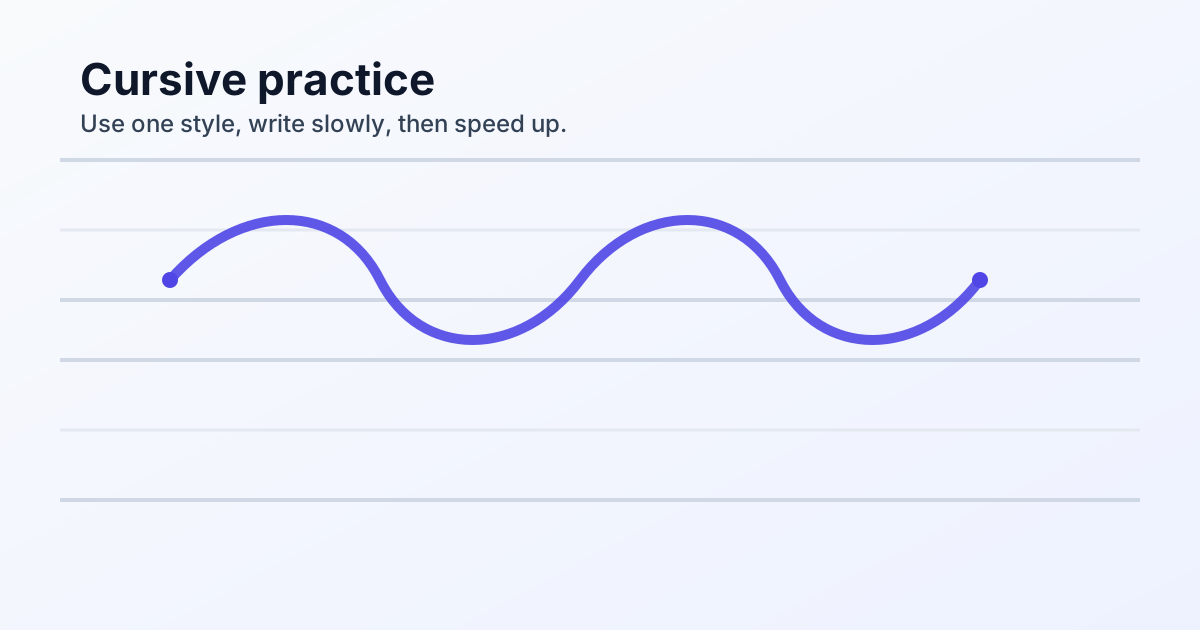
!how to write w in cursive practice sheet
External link (basic reference): Cursive
Quick overview: what makes a cursive w readable
A readable cursive **w** is basically **three smooth humps** (for lowercase) that stay consistent in:
- **Height:** all humps are the same size
- **Slant:** the letter leans the same way as the rest of your writing
- **Spacing:** you don’t crush the humps together
- **Exit stroke:** you leave the baseline cleanly to set up the next letter
If your w looks wrong, it’s usually because one hump is taller/shorter than the others, or your pen lifts mid-letter.
How to write a lowercase w in cursive (step by step)
Use lined paper if you can. Go slow at first, then speed up only when the shape is consistent.
Step 1: Start with a light entry stroke
Begin on the baseline and make a gentle upstroke into the first downstroke. Keep it light and smooth.
Step 2: Make the first hump
Come down to the baseline, curve up to the midline, then back down again. Avoid sharp corners—aim for a rounded “u” shape.
Step 3: Repeat for the second and third humps
Repeat the same motion twice more, keeping the humps:
- the same height
- the same width
- evenly spaced
Step 4: Finish with a clean exit stroke
After the third hump, finish with an exit upstroke that points toward the next letter (usually to the midline). This is what keeps words flowing.
How to write an uppercase W in cursive (two common options)
Uppercase cursive **W** is less standardized than lowercase letters. These two patterns are common in many cursive alphabets:
- **Looped W:** a larger entry loop, then wide downstrokes with rounded turns
- **Simple W:** a cleaner, less loopy version that looks closer to a smooth printed W, but with cursive joins
If your school provides an alphabet chart, follow that exact form—uppercase styles differ the most.
Option A: Looped uppercase W (beginner-friendly)
- Start with a larger entry stroke/loop near the top line.
- Pull down to the baseline for the first main stroke.
- Curve up and over for the second stroke, keeping it wider than lowercase.
- Repeat the pattern so the letter has **three main turns** and ends with a confident exit stroke.
Option B: Simple uppercase W (fast and readable)
- Start near the top line with a slight lead-in.
- Draw a downstroke to the baseline.
- Make two more smooth peaks like a wide lowercase w.
- Finish with an exit stroke that sets up the next letter.
If your uppercase W keeps looking like lowercase, make it **wider** and **taller** than the rest of the word.
Connecting w in cursive (real-word tips)
Lowercase **w** connects well to many letters, but these situations cause the most confusion:
w + e / w + a
In words like **we** or **wa**, your exit stroke should point slightly upward so you don’t crash into the next letter.
r / v vs w confusion
If your w looks like **v** or **r**, it’s usually a spacing problem:
- **v** has two strokes (one point).
- **w** has three humps (two extra turns).
- **r** is shorter and often has a simpler shoulder.
Count the humps while you’re learning.
Keep w from turning into a zigzag
If your w looks like a sharp zigzag, slow down and focus on **rounded turns**. You can practice by writing a row of connected “u” shapes first, then turning them into a w.
Quick practice drills (5-10 minutes)
Use these short drills to build consistency without burning out:
- **3 rows of humps:** write `uuu uuu uuu`, then convert each set into `w w w` without lifting your pen.
- **Connection pairs:** practice `wa we wi wo wu` slowly, focusing on the exit stroke.
- **Word reps:** pick one word (like “we” or “will”) and write it 10 times, aiming for identical w shapes.
Want a cursive-looking w to copy and paste?
Handwriting is best for notes and schoolwork, but sometimes you want a cursive-looking **w** for a username, bio, or design.
The safest approach is to generate matching text and test it where you’ll use it:
- Use the fonts tool to generate cursive-style text.
- If spacing matters, try blank space copy and paste.
- For symbols that match your style, browse copy and paste symbols.
Editorial note: “cursive” characters you copy and paste may render differently depending on the app, device, and font support. Always preview before publishing.
FAQ
Why does my cursive w look like a squiggle?
Usually it’s one of these:
- The humps are too close together.
- You’re making corners instead of rounded turns.
- Your slant changes mid-letter.
Slow down, practice `uuu`, and keep the humps evenly spaced.
Is cursive w just three u’s?
For many common lowercase cursive styles, yes—lowercase **w** is very similar to three connected “u” humps with a clean exit stroke.
What’s the easiest uppercase cursive W?
A simple, wide uppercase W (a larger version of lowercase w) is often the easiest to learn. If your class requires a looped form, practice the loop slowly so it stays smooth and readable.
Can I type a cursive w on my keyboard?
Standard keyboards don’t have a “cursive w” key. If you need a cursive-looking w digitally, generate it using fonts and test it in the app or website where you’ll paste it.
---
Bahasa Indonesia
SEO summary (<=100 chars): Cara menulis huruf w sambung: tiga “hump”, sambungan rapi, latihan cepat.
Focus Keyword: cara menulis huruf w sambung
Meta description (ID): Cara menulis huruf w sambung (kecil & besar) dengan langkah, sambungan, dan latihan cepat.
Untuk **cara menulis huruf w sambung**, bayangkan `u` yang diulang tiga kali, lalu keluar dengan exit stroke halus.
External link: Cursive
---
Русский
SEO summary (<=100 chars): Как писать w курсивом: три “бугорка”, соединения и быстрые упражнения.
Focus Keyword: как писать w курсивом
Meta description (RU): Как писать w курсивом (строчную и заглавную) с соединениями и короткими упражнениями.
Для **как писать w курсивом** считайте “горбики”: у `w` их три, и они должны быть одинаковыми.
External link: Cursive
---
Français
SEO summary (<=100 chars): Écrire w en cursive: trois bosses régulières, liaisons et drills rapides.
Focus Keyword: comment écrire w en cursive
Meta description (FR): Comment écrire w en cursive (minuscule/majuscule) avec liaisons et exercices.
Pour **comment écrire w en cursive**, fais trois bosses identiques, sans angles trop pointus.
External link: Cursive
---
Deutsch
SEO summary (<=100 chars): w in Schreibschrift: drei gleichmäßige Bögen, Verbindungen und kurze Übungen.
Focus Keyword: w in Schreibschrift
Meta description (DE): w in Schreibschrift (klein + groß) mit Schritten, Verbindungen und schnellen Übungen.
Für **w in Schreibschrift**: drei gleich hohe Bögen, sauberer Abstand, dann Ausstrich.
External link: Cursive
---
한국어
SEO summary (<=100 chars): 필기체 w 쓰는 법: 3번의 곡선, 연결, 짧은 연습 드릴.
Focus Keyword: 필기체 w 쓰는 법
Meta description (KO): 필기체 w 쓰는 법(소문자·대문자)과 연결, 빠른 연습 드릴을 정리했어요.
**필기체 w 쓰는 법**은 `u` 모양을 세 번 반복한다고 생각하면 훨씬 쉬워져요.
External link: Cursive
---
العربية
SEO summary (<=100 chars): كيفية كتابة w بخط متصل: ثلاث انحناءات متساوية مع وصلات.
Focus Keyword: كيفية كتابة w بخط متصل
Meta description (AR): كيفية كتابة w بخط متصل (صغير وكبير) مع خطوات واضحة وتمارين سريعة.
لـ **كيفية كتابة w بخط متصل** تخيل حرف `u` ثلاث مرات، مع انحناءات ناعمة وخروج خفيف.
External link: Cursive