
Published 2026-05-14 / Updated 2026-05-30
How to Write S in Cursive (Lowercase s and Uppercase S) + Easy Practice Tips
How to write s in cursive (lowercase and uppercase) with simple steps, joins, and quick fixes. Focus keyword: how to write s in cursive.
Article type: Copy and paste guide
Unicode characters may render differently by device, browser, app, and font. Test decorative text in the exact place where you plan to use it.
English
SEO summary (<=100 chars): How to write s in cursive with smooth curves, clean joins, and quick fixes.
Focus Keyword: how to write s in cursive
Meta description (EN): How to write s in cursive (lowercase + uppercase) with steps, joins, and easy fixes.
If you searched **how to write s in cursive**, you’re probably stuck with one of these problems:
- Your lowercase **s** looks like an **r**, **e**, or a messy loop
- Your cursive **s** breaks the flow when connecting to the next letter
- You’re not sure what an uppercase cursive **S** is supposed to look like
Cursive letter shapes vary by school and country, so the goal here is to learn a **clear, common structure** you can adapt to the style you’re using.
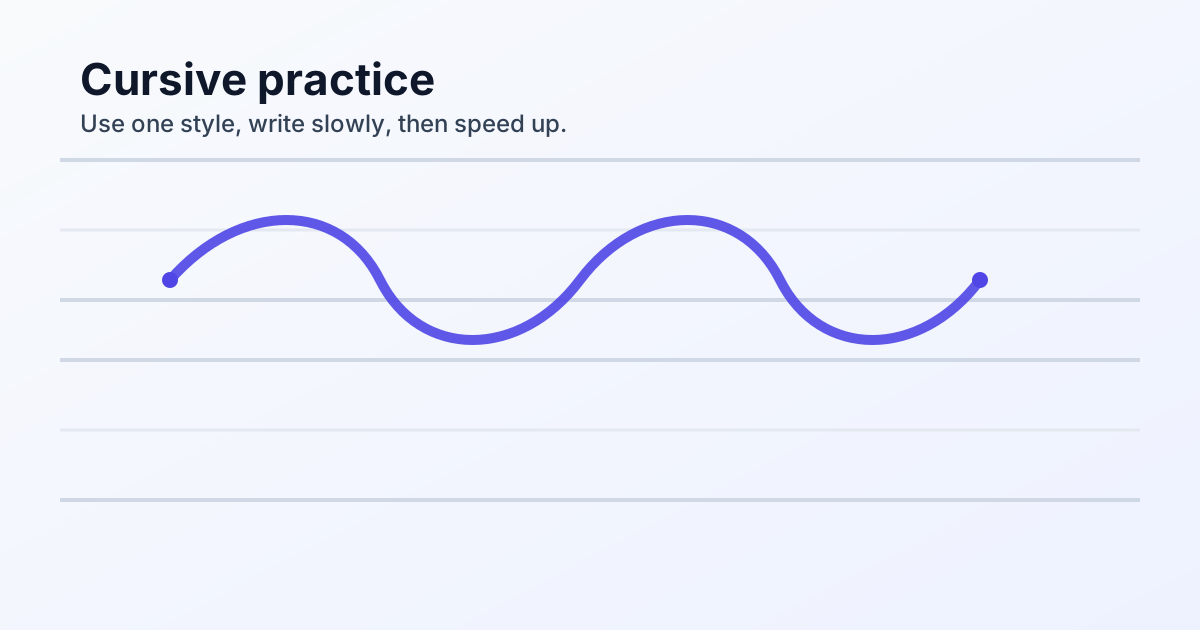
!how to write s in cursive practice sheet
External link (basic reference): Cursive
Quick overview: what makes a cursive s readable
A readable cursive **s** usually has:
- A **smooth entry** (no sharp angles)
- A **clear center curve** (so it doesn’t collapse into a blob)
- A **clean exit stroke** that sets up the next letter
If your s looks wrong, it’s often because you’re squeezing it too small, changing slant mid-letter, or exiting too steeply.
How to write a lowercase s in cursive (step by step)
Think of lowercase cursive **s** as a compact letter made from two gentle curves. Keep it about the height of other short letters (like **a**, **e**, **o**).
Step 1: Start with a light entry stroke
Begin on (or just above) the baseline with a small upstroke. Keep it light—this helps the letter stay smooth.
Step 2: Make the first curve (up and over)
Curve up and slightly right, then back down toward the middle. Avoid making a tight loop; a tight loop is what often turns the s into a smudge.
Step 3: Create the second curve (down and around)
Continue into a second curve that swings down and around, then returns toward the baseline. The letter should look like a small, flowing “wave” rather than a circle.
Step 4: Finish with a forward exit stroke
End with a short exit stroke heading up and to the right, ready to connect to the next letter.
Common lowercase s connections (so words look smooth)
Most frustration comes from the join after **s**. Practice these common patterns:
- **sa, se, so** (easy open joins)
- **st, sl, sh** (watch the angle so it doesn’t kink)
- **ss** (keep the second s slightly smaller so it doesn’t become a blob)
Tip: When connecting to tall letters like **t** or **l**, keep the exit stroke light and slightly upward so you don’t “crash” into the next downstroke.
How to write an uppercase S in cursive (simple approach)
Uppercase cursive **S** varies more than lowercase. Many people use a simplified capital S that still flows with the word.
A practical way to learn it:
- Start slightly above the midline with a gentle curve right.
- Sweep down into a larger curve left, then back right—like a stretched, elegant “S” shape.
- End with a small exit stroke into the next letter (if your style connects capitals).
If your capital S keeps looking too fancy or inconsistent, it’s OK to use a simpler printed **S** in handwriting while you build confidence. Readability matters more than decoration.
What to do if your cursive s looks messy (quick fixes)
“My s looks like an r”
- Make the top curve **rounder** and slightly wider.
- Don’t cut the letter short—finish the second curve before exiting.
“My s looks like an e”
- Reduce looping. An **s** should feel more like **two curves**, not a closed loop.
- Keep the center of the letter open (don’t pinch it).
“My s turns into a blob in words”
- Write slightly larger for a few days.
- Slow down on the exit stroke (it controls the next letter).
- Keep consistent slant across the whole word.
A simple 7-day practice plan (10 minutes/day)
Use any pen or pencil that writes smoothly.
- **2 minutes:** warm-up curves (light undercurves and overcurves)
- **3 minutes:** a line of single lowercase **s**
- **3 minutes:** a line of joins (rotate: **sa**, **se**, **st**, **sl**, **sh**)
- **2 minutes:** one short sentence using many s’s (example words: *see*, *so*, *still*, *stars*)
Keep the goal simple: one consistent slant and clean joins.
Want cursive text you can copy and paste instead?
If your goal is *digital* cursive for a bio, caption, or design note, use CopyBox’s fonts tool to convert normal text into decorative styles you can copy and paste.
Note: Decorative Unicode text can render differently across apps, devices, and fonts. Always test the result where you plan to use it.
Related CopyBox pages and guides
- fonts for cursive-style text you can copy and paste
- copy and paste symbols to pair with cursive captions
- blank space copy and paste for spacing tricks (test in the target app)
- copy and paste guides for practical copy/paste help
- Related posts: How to Write in Cursive, How to Write B in Cursive
FAQ
Is there one “correct” cursive s?
No. Cursive alphabets differ by region and teaching style. Use a clear version that matches the rest of your letters and stays readable in words.
Why does my s look different from examples online?
Many examples use different cursive styles (or even decorative fonts). Focus on consistent slant, spacing, and joins in your own handwriting rather than matching one exact shape.
Should uppercase cursive S connect to the next letter?
It depends on the style you’re learning. Some cursive systems connect capitals; others don’t. If you’re unsure, don’t force the connection—write a clean capital and start the next letter normally.
---
Bahasa Indonesia
SEO summary (<=100 chars): Cara menulis huruf s sambung dengan kurva halus dan sambungan rapi.
Focus Keyword: cara menulis huruf s sambung
Meta description (ID): Cara menulis huruf s sambung (kecil & besar) dengan langkah, sambungan, dan perbaikan cepat.
Untuk **cara menulis huruf s sambung**, jangan bikin loop terlalu kecil. Pakai dua kurva lembut dan exit stroke ringan.
External link: Cursive
---
Русский
SEO summary (<=100 chars): Как писать s курсивом: две плавные кривые, соединения и быстрые исправления.
Focus Keyword: как писать s курсивом
Meta description (RU): Как писать s курсивом (строчную и заглавную) с соединениями и простыми исправлениями.
Для **как писать s курсивом** держите форму компактной, но не “зажатой”: две плавные кривые + чистый выход.
External link: Cursive
---
Français
SEO summary (<=100 chars): Écrire s en cursive: deux courbes douces, liaisons propres et fixes rapides.
Focus Keyword: comment écrire s en cursive
Meta description (FR): Comment écrire s en cursive (minuscule/majuscule) avec liaisons et corrections simples.
Pour **comment écrire s en cursive**, vise “deux courbes” plutôt qu’une boucle fermée.
External link: Cursive
---
Deutsch
SEO summary (<=100 chars): s in Schreibschrift: zwei sanfte Kurven, saubere Verbindungen und Fixes.
Focus Keyword: s in Schreibschrift
Meta description (DE): s in Schreibschrift (klein + groß) mit Schritten, Verbindungen und schnellen Fixes.
Für **s in Schreibschrift**: zwei weiche Kurven, nicht zu eng - dann ein leichter Ausstrich.
External link: Cursive
---
한국어
SEO summary (<=100 chars): 필기체 s 쓰는 법: 부드러운 곡선 2개, 연결, 빠른 수정 팁.
Focus Keyword: 필기체 s 쓰는 법
Meta description (KO): 필기체 s 쓰는 법(소문자·대문자)과 연결, 흔한 실수 해결을 정리했어요.
**필기체 s 쓰는 법**은 작은 동그라미를 만들기보다, 곡선 두 번으로 “물결”처럼 쓰는 게 더 깔끔해요.
External link: Cursive
---
العربية
SEO summary (<=100 chars): كيفية كتابة s بخط متصل بمنحنيين ناعمين ووصلات واضحة.
Focus Keyword: كيفية كتابة s بخط متصل
Meta description (AR): كيفية كتابة s بخط متصل (صغير وكبير) مع وصلات ونصائح تصحيح سريعة.
لـ **كيفية كتابة s بخط متصل** استخدم منحنيين ناعمين وخروجًا خفيفًا بدل حلقة صغيرة مغلقة.
External link: Cursive