
Published 2026-05-12 / Updated 2026-05-30
How to Write in Cursive: A Step-by-Step Beginner Guide
How to write in cursive: simple strokes, easy practice steps, and readable joins. Focus keyword: how to write in cursive.
Article type: Copy and paste guide
Unicode characters may render differently by device, browser, app, and font. Test decorative text in the exact place where you plan to use it.
English
SEO summary (<=100 chars): Learn how to write in cursive with simple drills and clean joins.
Focus Keyword: how to write in cursive
Meta description (EN): How to write in cursive with easy drills, joins, and a simple daily plan.
You're here for **how to write in cursive**. Let's keep it simple and actually useful.
Most people want one of these:
- Smoother handwriting for school, notes, journaling, or a signature.
- Cursive-looking text you can copy and paste for a bio, caption, or design.
We'll do handwriting first (because that's the real skill), then I'll show the CopyBox shortcut for digital text.
Quick start (3 minutes)
If you only have a few minutes today, do this:
- Pick one cursive alphabet chart and **stick to it** (don't mix styles).
- Write one line of `uuu` (rounded humps, same size).
- Write one line of `ininin` (simple joins).
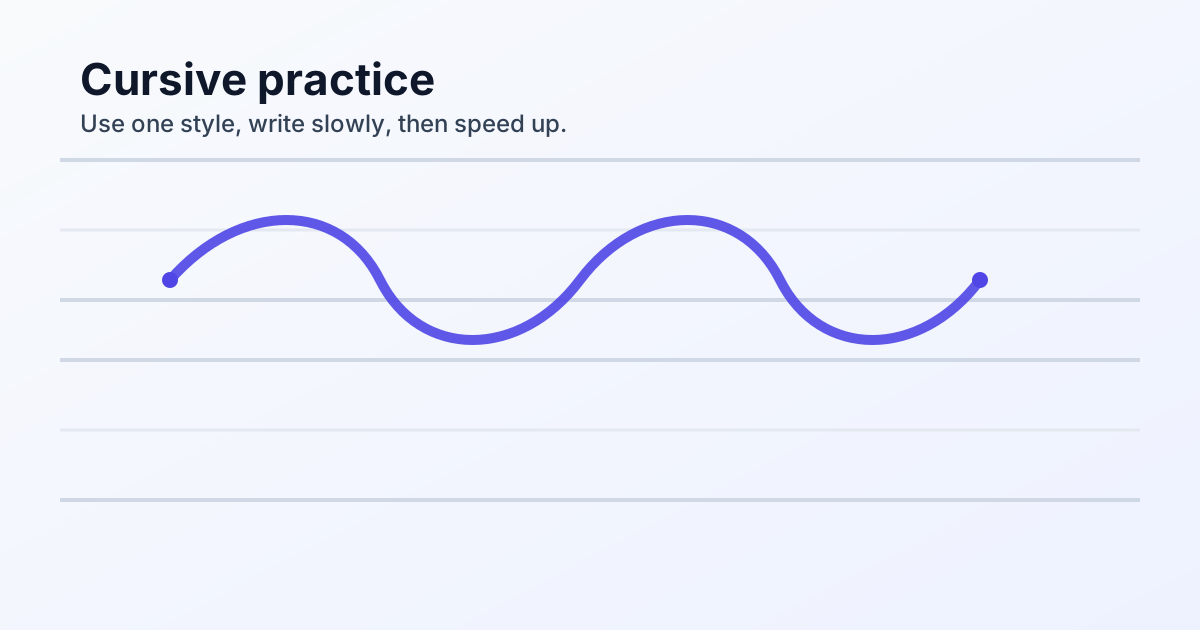
!how to write in cursive practice sheet
What "cursive" means (and what it doesn't)
Cursive is a handwriting style where letters are often connected to help you write faster and more fluidly. It's not one universal font - different schools and countries teach different cursive styles, and your personal handwriting will develop its own look over time.
If your goal is "pretty cursive," focus on **consistency and readability** before decoration.
External link (learn the basics): Cursive
What you need to start
Keep it simple - good basics beat fancy tools.
- **Paper:** lined paper (wide-ruled is easier at first)
- **Pencil or pen:** choose something that doesn't skip
- **A reference alphabet:** pick one style and stick to it while learning
Tip: Use lines as your guide for height. Most letters should sit between the baseline and the midline, with tall letters reaching higher.
Step 1: Learn the core cursive strokes (5-minute drills)
Most cursive letters are combinations of a few repeatable strokes. Practice these before full letters:
- **Undercurve:** a light curve up from the baseline into the next stroke
- **Overcurve:** a curve that starts high and comes down into the baseline
- **Upstroke / downstroke:** consistent direction and pressure
- **Loop:** used in letters like l, e, f (depending on the style)
Do one line of each stroke slowly. Speed comes later.
Step 2: Start with easier lowercase letters
Lowercase is usually easier than uppercase because the shapes repeat more. Many beginners find these letters friendlier:
- **i, u, w** (similar "humps")
- **e, l** (simple loops in many styles)
- **n, m** (repeated arches)
Write one letter at a time, then write it in short groups like `iiiii`, `ununun`, `nnnnn`.
Step 3: Practice connecting letters (the real "cursive" skill)
The biggest leap is learning how one letter flows into the next. Instead of writing random letters, practice common connections:
- **in, on, an**
- **er, re, en**
- **th, ch, sh**
Write each pair slowly 10-20 times. Watch for:
- **consistent slant** (letters leaning the same direction)
- **consistent spacing** (gaps between words, not between letters)
- **clean joins** (no sharp angles unless your style uses them)
Step 4: Add uppercase letters (only after lowercase feels stable)
Uppercase cursive varies a lot between styles. Don't worry if your capital letters look different from the reference - many people use a simpler capital that still matches the flow.
Practical approach:
- Choose 3-5 uppercase letters you use often (like your initials).
- Practice them as **first letters** of words (for example: "Anna", "Ben", "Cathy").
- Keep the shape readable before making it fancy.
Step 5: Use a simple daily practice plan (10 minutes)
Consistency matters more than long sessions. Try this daily plan for a week:
- **2 minutes:** stroke drills (undercurve/overcurve)
- **3 minutes:** one lowercase letter line
- **3 minutes:** one connection pair line (like "th" or "in")
- **2 minutes:** one short sentence in cursive
Write slowly enough that you can recognize every letter later.
Common cursive problems (and quick fixes)
"My cursive is messy or unreadable"
- Slow down and make letters slightly larger.
- Focus on uniform height for a week (baseline to midline).
- Pick one reference style and stop switching alphabets.
"My letters don't connect smoothly"
- Practice only 2-letter connections for a few days.
- Make the exit stroke of the first letter lighter.
- Avoid lifting your pen inside a word until you're confident.
"Some letters look like other letters"
This is normal early on. Fix confusion by exaggerating the distinguishing feature:
- `r` vs `v`: make the `r` smaller and smoother
- `i` vs `e`: keep `e` more rounded and closed
- `n` vs `m`: ensure `m` has three strokes (not two)
Want cursive text you can copy and paste instead?
If your goal is digital cursive (for a bio, caption, or design note), use CopyBox's fonts tool to convert normal text into decorative styles you can copy and paste.
Editorial note: decorative Unicode text may render differently across devices, apps, and fonts. Always test the result where you plan to use it.
Related CopyBox pages
- fonts for decorative text styles you can copy and paste
- copy and paste symbols to pair with handwritten-style captions
- copy and paste guides for practical copy/paste help
- blank space copy if you need spacing tricks for bios (test in the target app)
FAQ
How long does it take to learn cursive?
It depends on how often you practice. With a short daily routine, most beginners see cleaner, more consistent writing within a couple of weeks. Aim for steady improvement rather than perfection.
Should I learn cursive lowercase or uppercase first?
Lowercase first. It's more repetitive and builds the connections that make cursive feel natural.
Do I need a special pen for cursive?
No. Start with a pencil or any pen that writes smoothly. Once your letter shapes are consistent, you can experiment with different pens for style.
---
Bahasa Indonesia
SEO summary (<=100 chars): Cara menulis huruf sambung dengan latihan singkat dan rapi.
Focus Keyword: cara menulis huruf sambung
Meta description (ID): Cara menulis huruf sambung dengan latihan mudah, sambungan huruf, dan rencana harian.
Kalau kamu mencari **cara menulis huruf sambung**, biasanya kamu ingin tulisan tanganmu lebih halus dan mudah dibaca.
Langkah cepat:
- Pilih satu contoh alfabet huruf sambung (jangan ganti-ganti).
- Latih 5 menit “core strokes” (garis naik, turun, lengkung).
- Mulai dari huruf kecil yang mudah (i, u, w, n, m).
- Baru latihan sambungan (in, an, th).
Untuk teks huruf sambung digital yang bisa dicopy-paste, coba fonts.
External link: Cursive
FAQ singkat:
- Mulai dari huruf kecil dulu, baru huruf besar.
- Jangan buru-buru; rapi dulu baru cepat.
---
Русский
SEO summary (<=100 chars): Как писать курсивом: простые штрихи, соединения и план.
Focus Keyword: как писать курсивом
Meta description (RU): Как писать курсивом: простые упражнения, соединения букв и короткий план на неделю.
Если вы ищете **как писать курсивом**, начните с простого: один стиль, медленно, и много повторений.
Мини-план:
- Возьмите один образец алфавита и держитесь его.
- 5 минут штрихов (дуги, овалы, вверх/вниз).
- Сначала строчные (i/u/w, n/m), потом соединения.
- Заглавные — когда строчные уже читаемые.
Для “курсивного” текста в соцсетях попробуйте fonts.
External link: Cursive
---
Français
SEO summary (<=100 chars): Écrire en cursive: traits simples, liaisons propres, routine courte.
Focus Keyword: comment écrire en cursive
Meta description (FR): Comment écrire en cursive avec des exercices faciles, des liaisons et un plan quotidien.
Pour **comment écrire en cursive**, le secret est la régularité: même inclinaison, mêmes hauteurs, mêmes liaisons.
Routine rapide:
- Choisissez un seul alphabet modèle.
- Échauffez-vous 5 minutes (courbes, ovales).
- Travaillez les minuscules faciles, puis les liaisons.
- Ajoutez les majuscules à la fin.
Texte cursif à copier-coller: fonts.
External link: Cursive
---
Deutsch
SEO summary (<=100 chars): Kursive schreiben: einfache Striche, saubere Verbindungen, kurzer Plan.
Focus Keyword: wie schreibt man in Schreibschrift
Meta description (DE): Wie schreibt man in Schreibschrift: einfache Übungen, Verbindungen und ein kurzer Tagesplan.
Wenn du **wie schreibt man in Schreibschrift** suchst, fang klein an: ein Stil, langsam, oft wiederholen.
Kurzplan:
- Eine Vorlage wählen (nicht ständig wechseln).
- 5 Minuten Grundstriche üben.
- Erst Kleinbuchstaben, dann Verbindungen.
- Großbuchstaben erst später.
Für digitale Schreibschrift: fonts.
!wie schreibt man in Schreibschrift
External link: Cursive
---
한국어
SEO summary (<=100 chars): 필기체 쓰는 법: 기본 획, 연결, 짧은 연습 루틴.
Focus Keyword: 필기체 쓰는 법
Meta description (KO): 필기체 쓰는 법을 기본 획과 연결 연습, 하루 루틴으로 쉽게 배워요.
**필기체 쓰는 법**은 “한 가지 스타일을 꾸준히”가 핵심이에요.
빠른 순서:
- 참고 알파벳(워크시트/교재)을 하나 정해요.
- 5분 기본 획(곡선, 오벌, 위/아래)을 연습해요.
- 쉬운 소문자부터 시작하고, 연결을 연습해요.
- 대문자는 소문자가 읽히면 그때!
디지털 필기체 느낌이 필요하면 fonts를 써보세요.
External link: Cursive
---
العربية
SEO summary (<=100 chars): تعلّم الكتابة بخط متصل بخطوات بسيطة وتمارين قصيرة.
Focus Keyword: كيفية الكتابة بخط متصل
Meta description (AR): كيفية الكتابة بخط متصل عبر تمارين سهلة، وصلات حروف، وخطة يومية قصيرة.
إذا كنت تبحث عن **كيفية الكتابة بخط متصل**، ابدأ ببساطة: اختر نموذجًا واحدًا وتمرّن ببطء.
خطة سريعة:
- اختر جدول حروف واحدًا والتزم به.
- تمرّن 5 دقائق على الحركات الأساسية.
- ابدأ بالحروف الصغيرة السهلة ثم الوصلات.
- انتقل للحروف الكبيرة لاحقًا.
للنص المتصل الرقمي جرّب fonts.
External link: Cursive